Consulting at the interface of archaeology and the public
Thank you for stopping by. My name is Viviane Diederich. I am an archaeologist and I am writing my doctorate at the University of Bamberg, where I study how urban archaeology and the public deal with one another.
What interests me most is how people come together around cultural heritage: how archaeological knowledge is discussed, sometimes argued over, and what of it actually reaches a city.
Alongside my research I advise organisations, public authorities and developers who deal with these questions day to day.
My doctoral research asks where the practice of urban archaeology actually stands in today's society. So that the answer amounts to more than an opinion, I use empirical methods from communication studies.
That is unusual for the discipline, and it pays off. Archaeology long ago stopped happening only in the trench and in the specialist journal. It turns up in development plans, in the local paper, in town hall meetings, and in some fairly lively arguments about who owns what lies in the ground.
Many archaeological institutions communicate a great deal and still feel they are not getting through. Often that has less to do with the channel than with the fact that the organisation's own role has never been spelled out.
I work with you to clarify that role and to check what you want to achieve with it. This includes:
When archaeological requirements land on a building project, they look from the outside like delay and extra cost. Seen from the inside there are good reasons for them: a feature can only be excavated once. Whatever is not recorded in the process is gone for good.
I explain how heritage authorities think and work, which steps are coming and in what order. In my experience a requirement becomes far easier to live with once it can be planned for, rather than met as a surprise.
Since the Faro Convention, social participation has been part of how archaeology sees itself. In practice the questions then start: what should it actually look like, who has the time for it, and what happens when more people want a say than anyone expected?
I help with both halves. First with designing citizen science projects and other participatory formats, then with building them, so that a concept turns into an initiative people genuinely take part in.
If you would like to know more about my consulting work, or simply talk it over without obligation, please write to me.
Viviane Diederich
archaeologue@vivianediederich.de
viviane.diederich@uni-bamberg.de
Science communication is often confused with public relations, meaning whatever an institution sends outwards. In fact archaeological heritage is negotiated every single day: in heritage management, in museums, on social media, in volunteer initiatives, and in council and parliamentary sessions.
Here, for instance:
This is where it is decided what archaeology means in a city. So this is where I look first, before the press release.
My consulting is informed by perspectives from science communication research and the sociology of science. Rather than prescribing a single theoretical framework, it invites participants to reflect on the relationship between archaeology and the public through different conceptual lenses, and to relate these to their own professional experience.
One possible epistemic framework draws on Pierre Bourdieu's field theory together with Peter Weingart's work on science communication and knowledge orders. From this perspective, archaeology, public institutions, media, citizen initiatives and other social actors operate within different social fields, each shaped by its own logics, expectations and forms of knowledge.
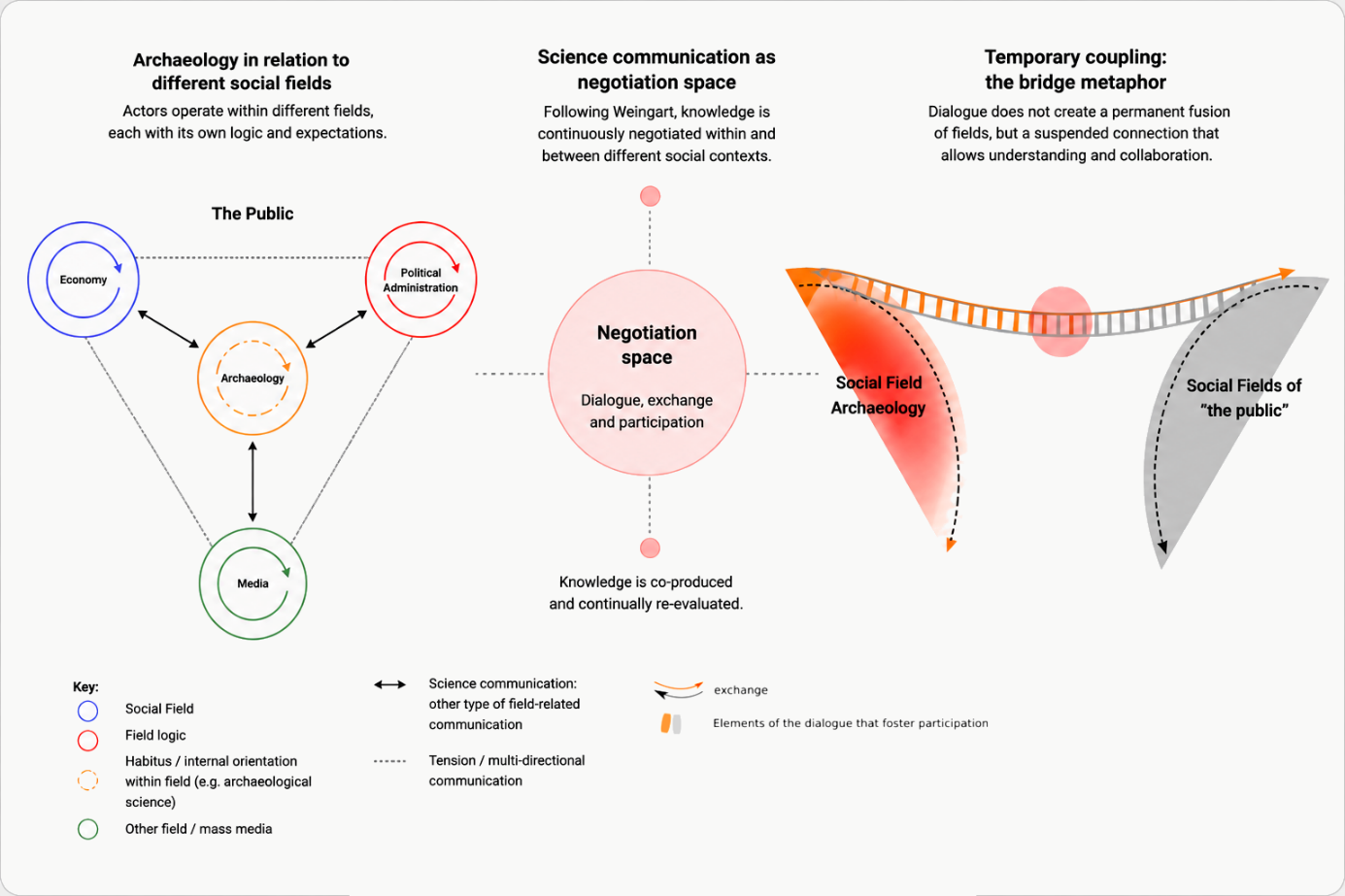
Following Weingart, scientific knowledge is understood as continuously negotiated within and between these contexts, rather than as something simply transferred between actors. The schema is an invitation: it helps us work through how dialogue, participation and collaboration emerge, where tensions arise, and which conditions support constructive exchange.
It is easy to picture science communication as a parcel carried from research to the public. Peter Weingart describes it differently: knowledge is produced and revised continuously, within social contexts and between them.
That makes a practical difference. If you treat communication as a relationship, you plan it over a longer horizon, you listen differently, and you stop measuring success by reach alone.
A find can hold up a building project for months. An excavation can confront a city with a part of its history it was not expecting. And a monument in the ground can turn political very quickly.
That is normal, and it cannot be smoothed away. What matters is that everyone involved understands what the argument is really about. Then it can be held.
The Council of Europe Framework Convention on the Value of Cultural Heritage for Society, usually shortened to the Faro Convention, puts a simple question at the centre: who is heritage actually for?
That brings into view the people who relate to a heritage, and not only the object itself. Participation becomes a task for archaeology rather than a friendly extra. What that means for the daily work of an authority, a museum or an excavation company is exactly the question I work on with my clients.
This sentence is where my work begins.
It means there is no public that merely receives culture. Whoever talks about an excavation, reports a find, protests against a building project or in favour of it, is already engaging with cultural heritage and making culture in the process.
Think of archaeology on one side and the public on the other, and that starting point is already lost.